
It was the year 2013. Kern Agrawal and his wife, Ranjini, had completed their MBA and MCA degrees, respectively. The couple landed jobs at Standard Chartered Bank, and it looked like the future was set. It was not exactly what Kern’s father, a Gemstone merchant, had in mind for his son, but it was a sure path for the upwardly mobile.
In 2014, when the couple started their family, they began to look more closely at the quality of food on the supermarket shelves. Not completely satisfied with what was available, Kern and his wife took a life-changing decision. “We leased a five-acre parcel of land on the outskirts of Chennai to grow our own food. The crop was paddy, and the first year was great. We were determined to avoid any chemicals on the land or the crop. After the first harvest, we realised that maybe it was beginner’s luck or perhaps residual fertiliser that the previous owner had used that gave us such a good yield,” recalls Kern.
Part research and part soul searching led them to question the quality of soil and its nutrients after each harvest. “I was a city boy, never grew even a money plant in my life. My wife, however, had some experience with backyard gardening,” he laughs. So, it was a huge step for them to quit their jobs and go further into the field, pun intended. They began to talk to farmers and customers and learnt some crucial lessons and understood that it was not an isolated problem but a national one. Growing clean food requires the land to be unpolluted, and that was (is) nearly impossible, given the immeasurable contaminants mankind returns to the land that gives us so much.
“In our first year, we were happy with the urban farming movement we had begun. We worked with schools and colleges to start small kitchen gardens and hosted awareness programs to show how to grow simple vegetables like bhindi and beans. We sold our organic produce to friends, family, and apartment complexes; we did well in the first year,” Kern reflects. However, these city dwellers wanted to address the root of the problem. They set out to ensure that only good-quality compost goes into the soil, one that’s not contaminated with plastics, chemicals, and urban non-biodegradable waste. The food waste mixed with these contaminants is generated by the hotels, restaurants, apartment complexes and homes. Once it is turned into fertiliser and sold to farmers, it steadily depletes the soil of its nutrients, resulting in substandard and decreasing yields year after year. A vicious cycle where urban and rural life is intertwined and, of course, interdependent to continue production.
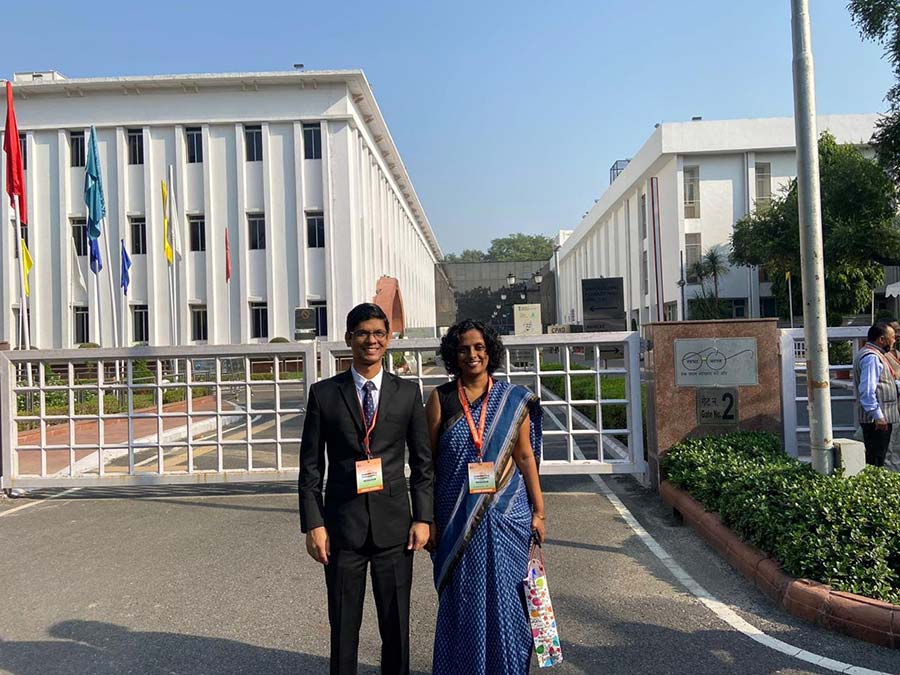 Kern and Ranjini, founders of Carbon Loops
Carbon Loops was founded in 2017 to address the dual problems of nutrient depletion in rural farming and food waste disposal in urban areas. “We aim to recycle urban food waste, convert it into a usable form for farmers, and direct it back to rural India,” Kern says. The company began by collecting food waste from various centres to turn into compost, which they took to farmers. “Then slowly, from composting, we moved to biofuel. You see, while composting, methane gas is released into the atmosphere. As our logical next step, we thought, why not capture it and use it positively? That’s how we got into biogas,” he explains.
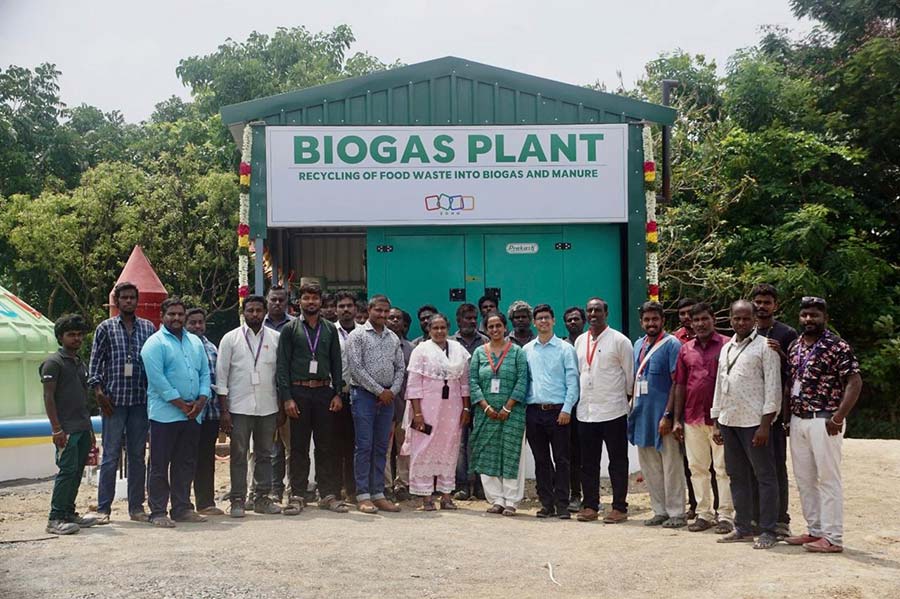
And that is how Carbon Loops works. All the urban food waste that the company collects from vegetable mandis and hotels/restaurants, they feed into specially designed biogas equipment at their state-of-the-art plant for the decomposition process. The gases are then collected and converted into electricity, cooking gas, and recently, vehicular fuel (CNG), while the residual manure is sent to farmers to fertilise their soil. Since 2017, the company has implemented 50 projects across Tamil Nadu, processing 100 metric tons of urban food waste every day by working with government bodies to set up and maintain biogas plants. The projects run through the length of Tamil Nadu, including cities such as Ooty, Kodaikanal, Valparai, Coonoor, Tirunelveli, Tuticorin, and Chennai, to name a few. It is a well-planned, carefully researched, and tested strategy that Kern follows to execute the projects.
“We approach local government bodies with our proposal to recycle urban food waste. So, they give us the land and the capital to set up the projects, we provide the technology, construct the biogas plant, and then maintain it for a period of five years,” explains Kern. The know-how comes from extensive research done by Kern and his team, which involved visiting over 100 waste management sites across India to understand successful and failed projects before developing their biogas technology. This included visiting projects from small, medium, and large-scale composting, waste management and biogas facilities, poring over the case studies and learning from their wrongs to do the right, and chalking up the dos versus the don’ts.
Kern gathered a lot of information during his research while studying various designs, models, and technologies. “Incidentally, I discovered that the origin of gobar gas is our own country. It goes back to India in the 1800s! Back then, in villages, people used to own one or two or more cows. They would build a small concrete tank below the ground in which they would process cow dung and use it as fuel for cooking. The West borrowed this technology, and today Germany, Korea and other countries have the latest in biogas technology and use it extensively, while we let it go,” he says sadly.
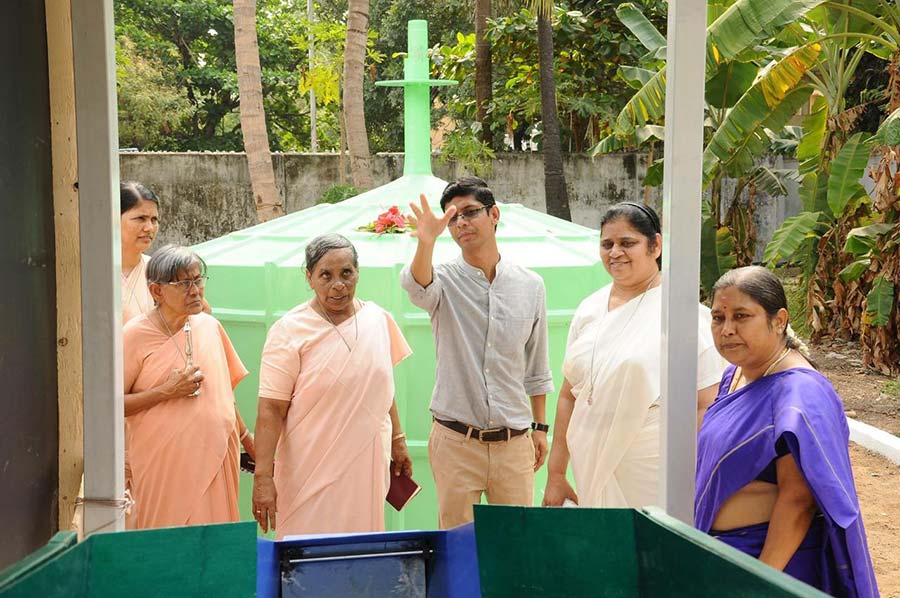 The company has set up programs in Loyola College, Stella Maris, Mahindra, and more
Carbon Loops began to receive positive feedback and soon built a good customer network. The company worked with Mahindra’s CSR initiatives to generate biofuel from food waste. Kern approached his alma mater, Loyola College, and explained how their food waste from the hostels could be recycled and got the opportunity to implement their project. After this, government projects began to pour in. Was it a daunting task for a couple of business and computer graduates with no science background to tread the unknown path of biofuel? Kern reflects, “Actually no, since we came with a fresh mind and no baggage. I guess if we were trained in science and tech, we would have been afraid of failure and preconceived notions. But this was organic growth, and we were, and are, always open to ideas. The difficult part was that we were on shaky ground financially. When my wife and I decided to quit the bank and venture into farming, we sank all our money into buying the land. We emptied our accounts.”
The journey has proved fruitful for this couple, although they faced quite a few challenges. “But I must admit, that was an amazing phase in our lives. We learnt so many things through this journey. Money management, how and what to buy for our business, and most of all, how to value the little things in life,” he laughs. The five acres they began with are long gone. Kern chuckles as he recalls the reason why. “Seeing how much the land began to yield, the owner kicked us out and took over farming that land himself.” Probably their paddy did really seem greener. This time round, Kern and Ranjini purchased their own land, on which they now grow paddy, fruits, and vegetables, apart from rearing goats, cows and chickens. A hundred per cent self-sustained farm!
Carbon Loops works across Tamil Nadu to set up biogas plants and create sustainable, waste-free systems
Carbon Loops has its office in IIT Madras Research Park. They have a team of 40 members, plus part-time employees who work at the various locations where they implement their projects. The company’s clients include Mahindra, Loyola College, Stella Maris College in Chennai, and the Government of Tamil Nadu in other cities and towns. The future is filled with promise and opportunities for Carbon Loops. Given the abundance of waste that urban areas generate, the possibilities are limitless. The company plans to increase the amount of urban food waste from 100 metric tons to 1000 metric tons in the next five years. It is now poised to upgrade its projects to LPG-grade fuel, reducing dependence on other countries for gas.
Carbon Loops as a company is on track to set and achieve its targets. However, the challenges are very real. Kern feels that waste management in India is not really a pressing issue because there are other problems that demand the attention of every government office, from local municipalities to the centre. “So long as waste is removed from the roads and you see clean surroundings, people consider the job done. What happens to the waste that is collected is the government’s problem; it does not concern them,” he worries. Secondly, people’s attitude towards garbage/ trash/ waste in India is a huge challenge, and they don’t really see the need to segregate wet/ dry/ recyclable waste, no matter how many bins there are on a street. “We can’t expect the sanitation workers to stick their hands in and sort out every bin. Swachh Bharat was beginning to make a difference, unfortunately, COVID hit, and we went back to our old habits. We need more awareness about the waste we generate and how and where it goes once it leaves our homes,” says Kern.
For now, it’s baby steps for Carbon Loops. Kern and Ranjini continue on their mission to provide clean and healthy fertiliser to farmers for their lands, while ensuring the best possible use of composted byproducts such as methane. They’ve hit upon a bankable idea to fuel our state.