
When you think of skincare today, the words ‘niacinamide’ and ‘peptides’ tend to be the most common. But what about neroli, kokum, or mango? Deepika Nagasamy wants to use her brand Dipsy to refocus consumers towards Indian ingredients in the beauty sector.
A dollop of an idea
Launched in November of 2025, Dipsy by Deepika Nagasamy aims to educate people about the host of Indian components that are inherently good for your skin. “We want to bring out native Indian ingredients into the limelight, along with the cultural influence they signify. We want to change the way skincare is looked at and prove that India, as a country, has so much to offer in the skincare realm.”
As for the brand name, she chuckles, “Dipsy is actually a nickname my sisters gave me when we were younger. It’s a quirky name, and it just felt right when I was thinking of names for the brand. I wanted to find my footing and make my presence felt by doing something on my own, and this came up at the perfect time. Working and starting a business wasn’t really new to me—I worked in textile design before this, and also had my own boutique where I made custom furnishings and clothing for women. After my kids were born, I went into event planning and designing again, and for about eight years, I handled the marketing for Dindigul Thalappakatti. I took a step back eventually and got into skincare formulation.”

Why choose between traditional and modern?
Deepika pursued Diplomas in organic formulation and other skincare-related courses, and gained enough confidence to start Dipsy. She does all the base formulations herself, which scientists double-check to make sure the products are skin- and market-safe. Dipsy has a third-party lab that does dermatological testing and assists with certifications.
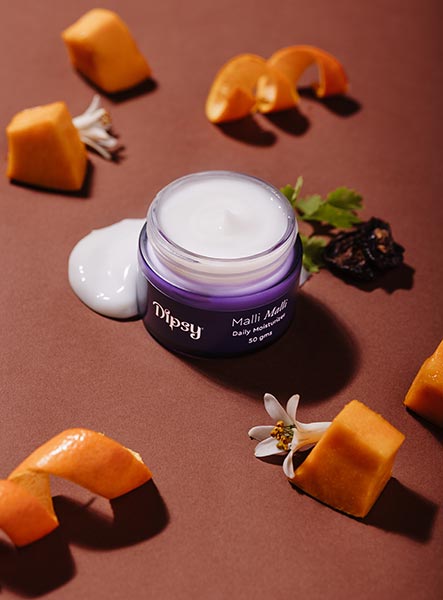
Talking about the ingredients used in the products, she says, “All our products are gender-neutral, and Indian ingredients really support that idea. A lot of what I pick is a result of going back to what I saw my mother and grandmother use, or what friends have told me about their families’ traditions. We follow up with scientific papers and research to reevaluate our thought process to see if it’s viable. Our first product, the Malli Malli moisturiser, is also a nod to my Telugu-Tamil heritage, where ‘malli’ means ‘coriander’ in Tamil, and ‘again’ in Telugu. It uses a mix of coriander, neroli, mango, and kokum.”
Kokum, she explains, is an ancient ingredient, so safe it can be used for babies too! Kokum oil or butter is something a lot of families use for their children, but it has been overshadowed by the fancier cocoa butter or shea butter nowadays. Mango butter, too, she adds, has numerous benefits, but is barely known or used. “Kokum and mango are ingredients grown in our soil, and I wanted to bring them back. They also have an emotional connect, work in our environment, and are highly versatile.”
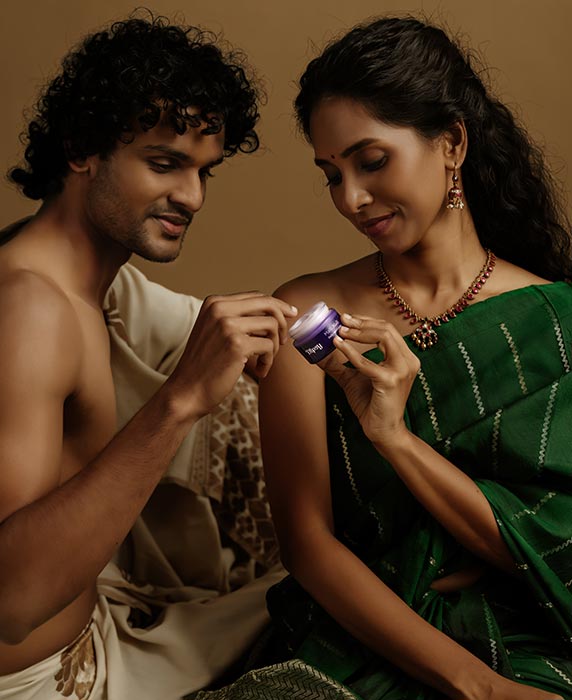
Confusion turned to inspiration
When asked about the inspiration behind starting Dipsy, she recalls, “When I wanted to get into skincare myself, I went down several rabbitholes on the internet about what to use and what not to use. It was too confusing, and I realised that I could come up with something on my own. That was when I found a myriad of ingredients that are native to India and just as effective as the components used by name brands. Dipsy is about getting your 7- or 8-step routine done and dusted in one or two steps. It’s been a long process getting here, but onward and upward!”
Coming to the challenges of running a business, Deepika mentions how often they had to go back to the drawing board to make changes to the products before launching. “A lot of times, I thought, okay, this is it. This is the right formulation. I’d make my friends and family try it out, and they’d tell me the smell or texture wasn’t quite there yet, so we’d restart the process. That, and the licensing and certification. Who knew there would be an endless list of nitty-gritty details?” she laughs. “It’s all part of the learning curve, though. You just have to stick with it.”
Recognising India’s natural potential
Stick with it, she did. Deepika describes the current beauty industry situation, “I think I’m part of one of the first generations of Indians who are starting to take care of our skin. Along with the younger generations, I believe we are armed with the knowledge of what to and what not to put on our skin. There is a lot of acceptance, growth, and space for us in the field. It’s not an easy industry to be in, what with new brands cropping up daily, but I stuck to my instinct, and I’m glad to say it’s working out well at the moment,” she smiles.
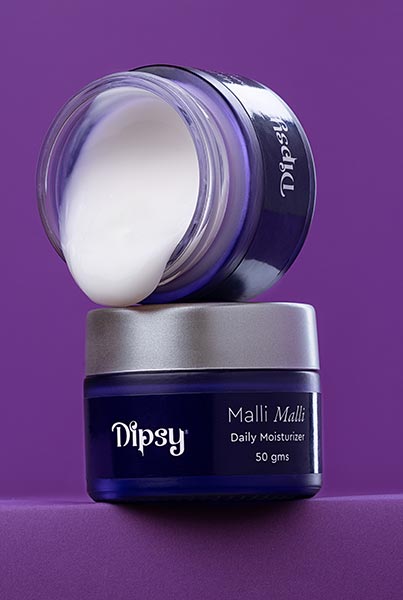
She talks about how Dipsy is in a unique position in the market. “I think Dipsy stands out from other brands majorly in terms of ingredients and packaging. When you look at natural, sustainable, organic skincare brands, they generally tend to use earthy colours and natural elements in their packaging to portray calmness and sensuality. Dipsy is not like that; we are bright purple and follow an entirely different colour scheme. We wanted to bring the feeling of luxury and lusciousness when you interact with a high-profile product. Our ideal customers are those in their 20s; those who know what they want. We want to target people who are looking for something visually interesting, portraying who we are as a culture altogether, which is vibrant. To me, India is not just shades of brown and green; we are every colour of the rainbow and more.”
Slow, intentional care
Describing their first launch, Deepika explains that they didn’t invite exclusive skincare enthusiasts; they invited people from all walks of life, including friends and family. She wanted all kinds of people to understand and use skincare mindfully, becoming part of their everyday rituals. A fashion influencer, a cultural voice from Kolkata, someone known for their quirky takes on food—the event had them all under one roof. “This was a launch for the people I wanted the brand to reach. We create slow, intentional skincare, and we’re hoping that, through Dipsy, it becomes as natural a daily ritual as brushing your teeth. Using a dollop of Dipsy’s products should bring a smile to your face and reset your day, whether it’s when you wake up or wind down.”
To conclude, she lays down her thoughts on the industry, Dipsy’s future, and her journey so far. “Unfortunately, a lot of people think Indian skincare is not scientifically backed, but it is. We’ve been using these ingredients for centuries, and we hope to spread the word using Dipsy that these are safe to use and absolutely beneficial. My skincare journey started around the same time my daughter started to experiment as well. I wanted her to have something she’d fall in love with and want to use every single day. I also hope Dipsy grows to a level where she can take it up in the future and grow it further.”
Dipsy is working on a new product, which is set to launch soon.