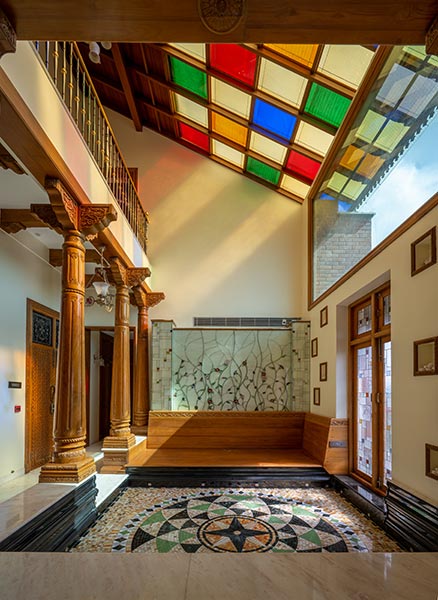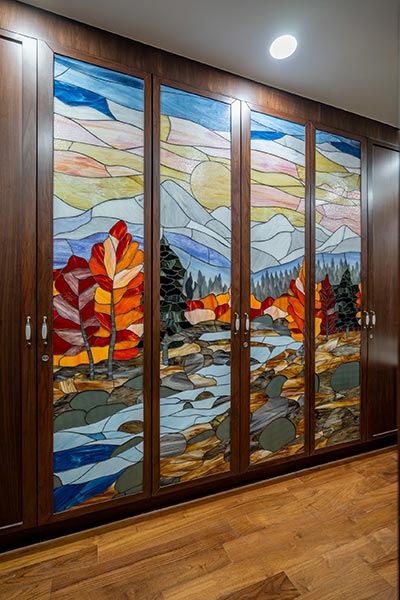

Aamena Millwala started tinkering around with stained glass as a hobby. Friends and family members’ interests were piqued. She started to customise them, gradually taking orders, and the rest is history.
Glassy-eyed beginnings
Aamena started Studio A 12 years ago, converting her balcony into a small home studio, once word spread about her work. “Stained glass in its original form is a dying art. Unfortunately, not too many people do it today. Across Chennai, there are only 3-4 of us. The main reason for its diminishing is how skill-oriented, labour-intensive, and expensive it is. We cut the glass, grind it, and solder it together. It requires a very high level of precision. Now, the fake stained glass art has taken over, where people use paints to mimic the authentic style. Ours is completely different, even though we use paint on occasion to fill in some details. We get our glass sheets pre-coloured, which we then cut. It’s a real challenge, but that’s what got me here, so it’s all good,” she smiles.
Speaking of what drove her towards stained glass, she explains, “In college, a friend asked me to help with a fake stained glass project. Immediately, I was drawn to how beautifully light passes through the coloured glass; I love the shadows it creates. The biggest problem with painted glass is that after a month of direct sunlight, the colours disappear. I wanted to pursue the art form, but through something that lasts, which is why I decided to go with the original craft, even though it is on the decline. I had a long gap when I came across someone who was making stained glass pieces in Chennai. I asked her to teach me first, and then I attended workshops in Singapore and Italy, vying to learn as much as possible. I am also a glass mosaic artist; we do both art forms at Studio A.”
 Aamena Millwala, the founder of Studio A, a stained glass and mosaic artist
The light at the end of the glass
Since the industry is dwindling and there aren’t too many people willing to teach the craft in detail, a lot has been learnt on the job, Aamena says. “I didn’t start this with the idea of it being a business; I kept getting recommended to people. It all happened very organically. Now, we’ve done stained glass roofs, glass mosaic floors, Tiffany-style lamps, walls, and so much more. I hope that, going forward, we can create more beautiful pieces and work with architects and interior designers who enjoy the old-world charm and appreciate quality and skilled craftsmanship.”
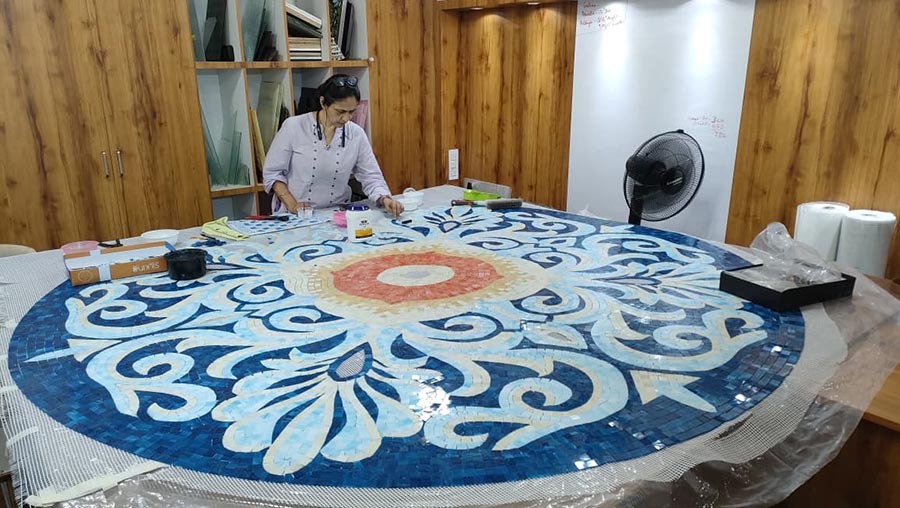 Aamena working on a big mosaic piece
She describes how people want original stained glass, but are not willing to pay the amount that is required. She hopes to take the brand and quality to a level where people understand the reasoning behind the cost. She wants to create awareness of how tedious the process is, how expensive the materials are, and how much skill is involved. Most importantly, she aims to bring joy into people’s homes and office spaces. She muses how seeing light pass through coloured glass is a true delight. The goal, she says, is to work with like-minded people who admire and respect the art form that they’re creating at Studio A.
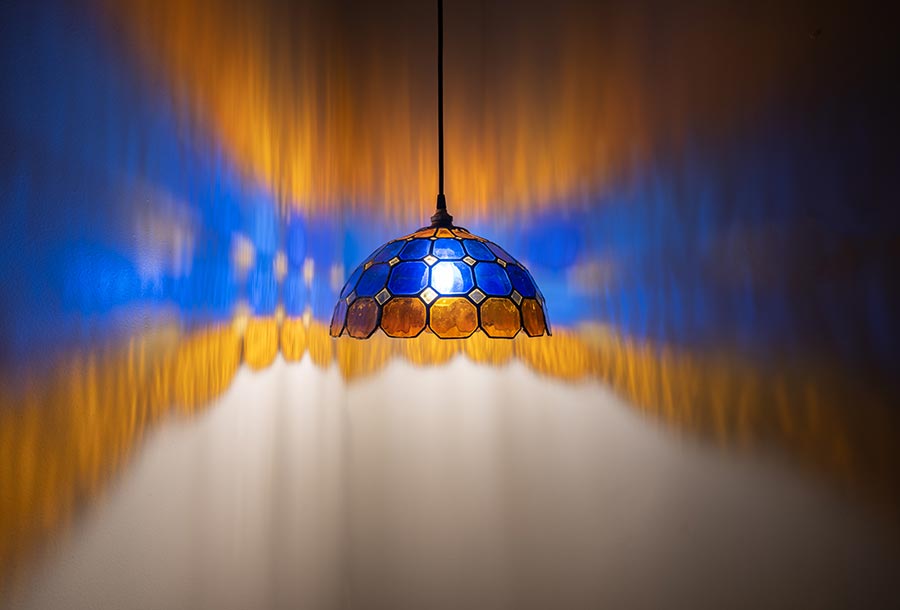 Tiffany-style lamp, beautifully reflecting the colours when the light hits
A colourful journey
On the topic of lessons learnt over the years, Aamena ponders before answering, “There are a lot, but I think some stand out. There are no shortcuts in this line of work; you work hard to get the best results. I knew from the beginning that I was willing to give it everything, and I continue to do so every day. Now, I’ve learned that you should never sell yourself short; that would be the biggest dishonour to the craft. You should stick to your ground, be confident in your skill, believe in yourself, and get what you deserve for your art. Explain the process to people, and explain the reasoning if you have to. If they’re still not convinced, that’s okay; but nine times out of ten, it does work out. As for taking a firm stance, the world pushes, everyone pushes, but you have to decide where to draw the line. Lay things out to the client upfront, be honest and transparent about timelines and costs, and stick to it. Trust works both ways!”
Talking about memorable client stories and milestones, she mentions some of her favourite projects, “We had this couple who asked us to make a piece for their house. We’ve been working with them for over four years now, and we’ve made 17-18 pieces so far. It’s an amazing feeling to know that someone trusts us enough to have so many pieces made, especially for an art form that is not very cheap. Another key piece of our journey has been architectural firms putting us down in their blueprints, deciding that the house/space is going to have a stained glass piece from us. It’s very validating to be able to get such wonderful opportunities and feedback,” she smiles.
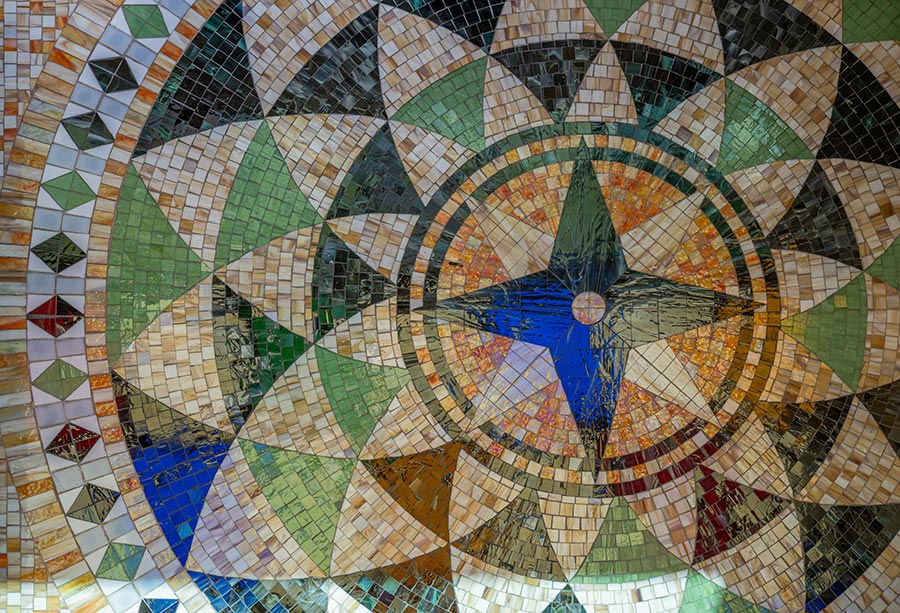 A full glass mosaic floor
Cutting-edge art
Walking through the creative process at Studio A, Aamena explains, “When we get a call from an owner or architect, we go see the space to gauge the requirements. We get a feel of the space to understand our scope of work ahead. We ask them what they have in mind, and then we send them some design references to get a clear idea and see if we’ve understood their brief. Once they tell us what elements they want, we start drawing. We worked on a homestay in Chikmangalur, where the owner wanted a stained glass door, incorporating a fig tree, peacocks, and bees. Any time we get a client, we design and redesign however many times it takes to get it right, and redo the colours and show them the glass samples until they’re 100% satisfied. We don’t try to sell it to them and convince them. It’s their space, and they have to be happy with it. That’s where the visualisation ends, and the real work begins.”
Getting into the production process starts with getting the glass imported either from the USA or China. She clarifies how stained glass is not a very Indian craft, hence why acquiring materials locally is a task. “Once we get our glass, we work on the final measurements and get the prints ready before cutting the glass. We trace each individual piece onto the coloured glass sheets, cut them by hand, grind the edges, and solder them together. We recently made an 8 x 4 feet peacock panel, which had 1200 pieces of glass. Since it’s a very high-precision art, it’s hard to fix mistakes. You can’t cover something up like in painting. Once our piece is ready, we transport it sandwiched between two clear toughened glass pieces. It’s a process that requires a lot of care and patience, and I am fortunate enough to have built a team that is as dedicated and passionate about the art form as I am,” she says proudly.
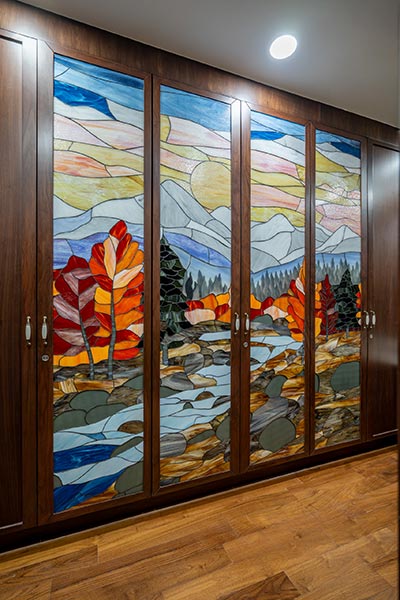
Shining on
Talking about the way forward, she reiterates how important it is to find clients who believe in the brand and how the team puts their best foot forward to bring their vision to fruition. She gives an example of another recent successful project, “There was a client who wanted a ceiling panel of 4 strips, making up the outer border, running at right angles. There was a caveat, though: at no point should the joints be seen; it had to look seamless. It was a complicated project, but I always somehow get myself into these things,” she laughs. “I say yes to everything and then figure a way out. In a way, learning is easier when you get to do it on the job. I’ve learned that anything can be done if you put your mind to it,” she concludes.