You think you know India. You think you know its art, history, and culture, most of it anyway. However, Gayathri KK knew that our knowledge was just skimming the surface, so she made it her mission to explore India’s rich tapestry of culture through textiles, one region at a time.
Gayathri KK is an independent textile researcher, specifically working with lesser-known textiles of Tamil Nadu. Most people only know Kanjeevaram and nothing beyond that. Countless textiles and pieces of tradition have gotten lost on the way. So why not bring it back? That was her goal when she started her brand and archive, Yatri.
Back in 2015, she was a corporate employee spending 3-4 hours commuting to and from work. She wanted to do something productive during that time, so she began reselling sarees. On social media, two hashtags caught her attention: Hundred Saree Pact and Sixty Handloom Saree Pact, which were part of a challenge to wear 100 sarees in a year, 60 of which had to be handloom. She began researching the differences between power looms and hand looms and fell into a rabbit hole, eventually discovering things that other people might miss. She became confident enough to stop reselling and start her own archival revival projects.
“I realised that we, as a state, are not limited to Kanjeevaram. COVID had just hit, and for our first project, we wanted to recreate an Ikat saree from the Victoria and Albert Museum archives. Back then, we had one loom, and we started the project because no one had much work. Now, we have 8-10 looms across Kanjeevaram, Arani, and Thanjavur, where we work with lesser-known textiles, weaving techniques, motifs, and patterns,” she says.
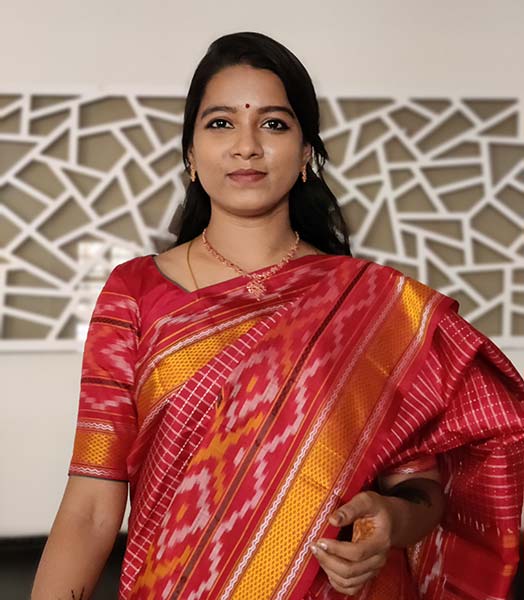
Gayatri got in touch with a weaver for the first Ikat saree, whose father is a National Award winner. All the winners are listed on a government website, and she reached out to different weavers to work with. “It’s usually awards for Kanjeevaram, but I spotted one who was awarded for a fabric called Kutni, which is the English iteration of Mashru from Gujarat. I was amazed that they had preserved this form of weaving, but they mostly made fabrics rather than sarees. I also found out that satin was made in a few regions of Tamil Nadu. Since that was my journey into textiles, I thought it would be apt to call it Yatri, which incidentally is part of my name,” she chuckles.
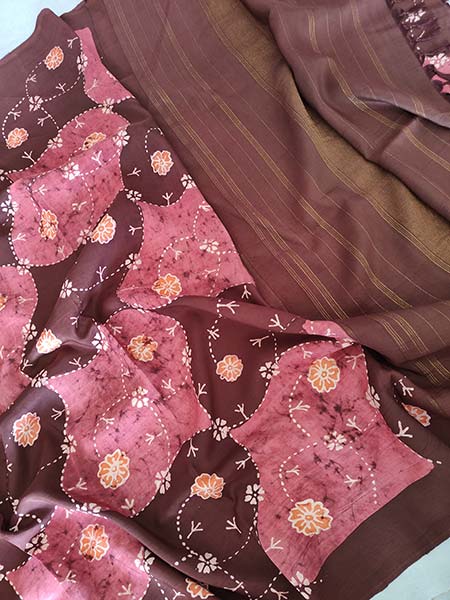
Yatri specialises in three things—painted, printed, and woven textiles, and on occasion, embellishments like beetle wing embroidery. In Madras, real beetles were used for the embroidery and exported to England to make gowns. As time went by, so did the method. Now, the Yatri team does it in very small batches. They are trying to revive a block printing technique from Kumbakonam, Kodalikaruppur, a rare, historic printed textile, and for the painting, they do Kalamkari and Batik. Both these forms were part of the Coromandel Coast, made in Kumbakonam, Nagapattinam, and Thirunelveli and exported to the rest of the country.
“I saw some black and white patterns in a book called Cotton Painting and Printing in the Madras Presidency, which we translated onto cloth. We also use archives from museums in Philadelphia and the Victoria and Albert Museums, which have a lot of patterns. We study them in detail and do our best to recreate them, faithful at least up to 90%. We found that there are some patterns that exist in two separate regions, finding commonalities in the Deccan and Tamil cultures, for example. Through research, we once found a particular Batik trident pattern that required different pens for the three-stripe and the single stripe. Textiles are fascinating markers of culture; you can start up a conversation with someone from the region about it and give them a piece of information they might not have known!” she exclaims.
As for selling these wonderful recreations, Gayatri has a catalogue with an approximate price range, but never an exact price. “I have built a system of absolute trust with my weavers because I pay them the price they quote me. I never bargain or argue; they know the value of their work, and I respect their incredible skill, making authentic textiles, no matter how long it takes. Prices of textiles and threads vary every few months, so I can’t set a fixed price, or they won’t be paid fairly,” she explains.
She talks about misconceptions about the handloom industry: “Not everything you see online branded as ‘real’ is actually real. There are only around 5000-6000 Kanjeevaram weavers, so how do you expect there to be so many sarees online, and for those prices? Speaking of the price, you can’t get a real Kanjeevaram saree for 3000 rupees, because raw silk itself costs around 8000 now. I’ve learnt so much over the years; it’s been such an eye-opening experience. My mentor asked me one simple question when I had the idea for Yatri—’If not you, then who?’ I carry it with me ever since,” she smiles.
She went on a Tamil TV show called Neeya Naana, where she did a segment on textiles. One of Yatri’s weavers was supposed to go on it, but at the last minute, he couldn’t, and Gayatri took his place. “The weavers were on one end, and the audience was on the other. I pointed to a weaver from Negamam and told them how the Romans used to wear togas made with that region’s cotton. I also told them how the Roman treasury was almost depleted because they bought such large amounts of cotton from here! The show took a wild turn from there,” she laughs. “The show created a lot of traction for our work. We’ve been able to take up amazing projects after the show’s telecast. We’ve also built beautiful relationships with our weavers, bringing them closer to their craft.”
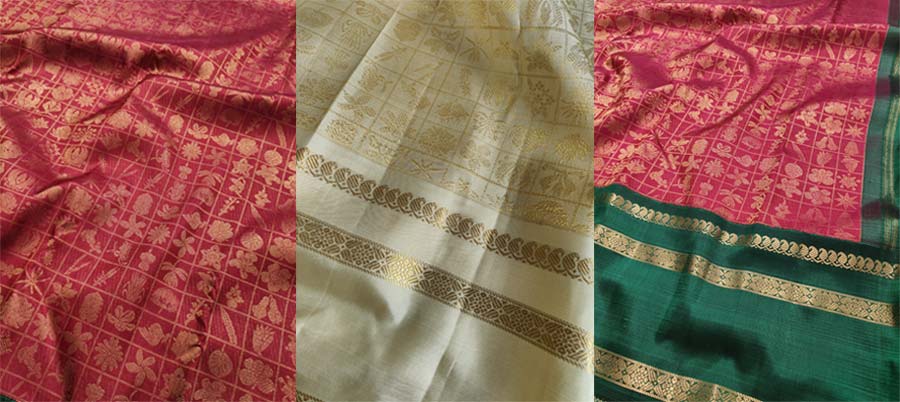
These pieces are a portrayal of Kurunjppaatu, or the 99 flowers song in Tamil, which Gayathri came across while researching. She got an artist to sketch the flowers, and her weavers translated them onto a saree, completing the 100-panel grid by repeating the first flower. The red saree and the gold matching outfit were part of a bridal customisation project.
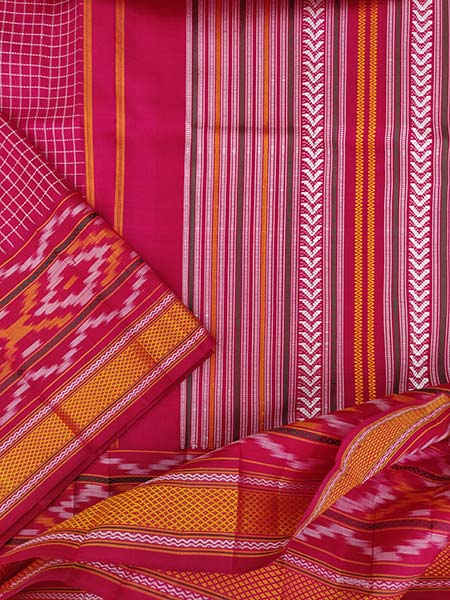
Gayatri recalls an incident with one of her weavers. “He told me how his grandfather used to weave a specific Ikat pattern and its name started with S, but he couldn’t recollect the exact word. When I was looking through archival material, I found a similar context and asked him if it was that, and it turns out it was! This is the reason we do what we do. It’s important to discuss these things and see how intricately textiles are intertwined with a place’s history. I used to work with this weaver’s father, who passed away a few years ago. Now, the son is the master weaver and has taken on his legacy. In the 1800s, only 7 weaver houses were doing the particular style, and now I’m working with someone who is a master of the trade all these centuries later. I think it’s wonderful,” she says proudly.
She brings up her first design project where she studied Sangam Tamil Literature and came across a song where 99 flowers were mentioned. She found a website where these flowers were documented, got an artist to sketch them for her, and with her weavers, got them turned into motifs on a saree, with the first flower repeated as the hundredth part of the grid. “My friend who was getting married wanted the same saree and a matching custom outfit woven in pure zari for her and her fiancee. It was my first bridal customisation, and something I will never forget,” she smiles.
To conclude, she talks about Yatri’s latest project: “We found a pattern called ‘Cotton Madras’. Through research, we considered the possibility that it was woven somewhere in the Kumbakonam area and wanted to recreate it. Kanjeevaram weavers don’t know how to weave Ikat, so we roped in a guy from Pochampalli to teach the Ikat weave to our weaver here. The beauty of it is, my guy doesn’t know Telugu and that guy doesn’t know Tamil. Somehow, buffering and tripping over words, they managed to come to an understanding. In the end, my weaver was able to tell the Telugu weaver ‘ardhamayyindi’ (I understand). It was a beautiful collaboration. Things like this keep me going.”