
Harish Varadharajan, Damien Lopez Salazar, and Timothy Chad van Niekirk started The Fragaria in 2024 to bring world-class fruits to the market 365 days a year. Wherever you get them, they taste the same, and the quality is just as good.
“My co-founders, Timothy, Damian, and I are aiming to build a fruit brand where you can get fruits every day, regardless of the season or unpredictable weather conditions. How do we achieve this? Through climate-independent fruit factories. Even though India is a mostly agricultural country, the variables involved in the success of crops are too many. We want to remove those variables through alternative farming methods. We’re working to improve the quality of life for millions of people by bringing them fresh fruits every single day,” Harish explains.
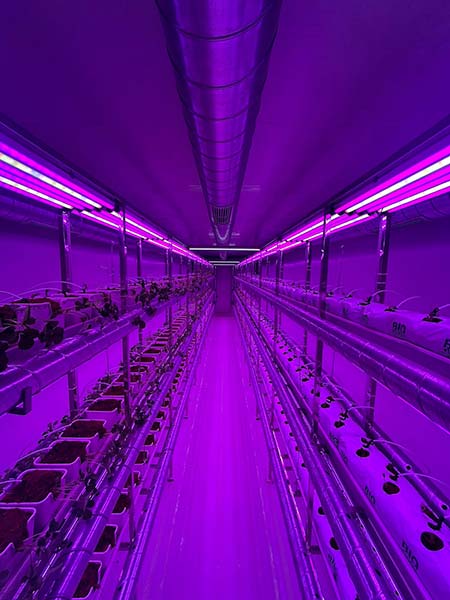
They have a small pilot farm in Chennai where they grow European strawberries all year round. With investors showing keen interest, they are now expanding to a farm 30 times bigger than the one in Chennai, and are also planning on setting up farms for blueberries, raspberries, European grapes, and Indian mangoes.
Among the team, Harish is the CEO who takes care of finance, strategy, funding, and marketing. Timothy is the COO; he designs the farms, oversees construction, and manages the growing. Damian is the CTO and the brains behind the operation, constantly working on developing tissue culture technology to clone the existing plants. Their individual backgrounds have culminated in a unique business idea.
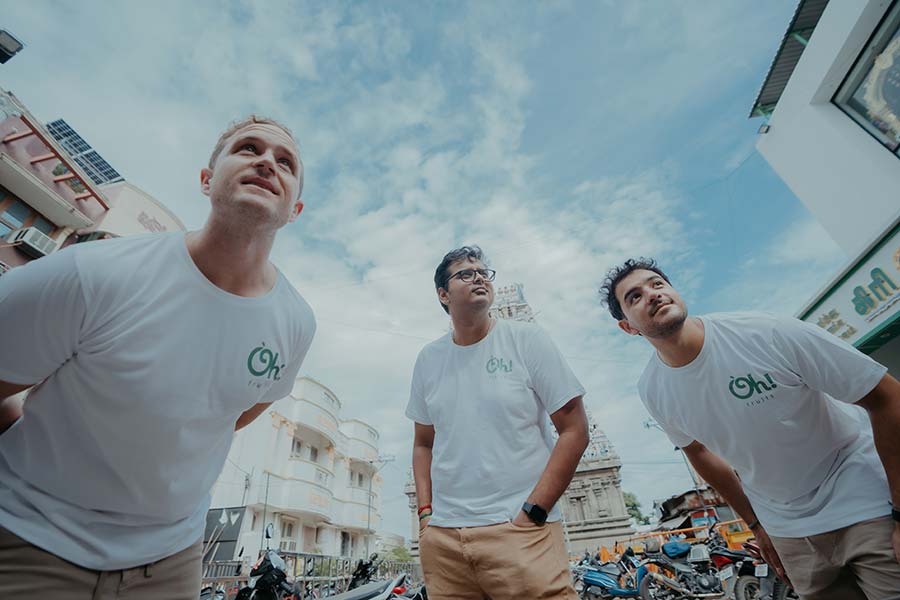 Timothy, Harish, and Damian, founders of The Fragaria
Harish worked as a consultant in India and Dubai for a few years. Eventually, he decided to switch careers, and he landed at Pure Harvest, a smart farm company, where he met Timothy, his co-founder from South Africa. “Timothy was in charge of growing, and I was on the operations and funding side of things. Both of us received an opportunity from a company in Amsterdam, so we moved there. That’s where we met Damian, from Mexico, who was involved in plant and fruit research. Tim and Damian were at the same college in the Netherlands, which is like the Stanford of agriculture, so both have immense knowledge of the topic. They were, at the time we met, developing technology to grow strawberries indoors. I pitched to them that we should do this for ourselves and do it in India. If it works, we expand globally. If it doesn’t, we move back to Amsterdam. Lucky for us, looks like we’re here to stay,” he smiles. “I’m a proud Tamilian, and I felt like if something new were to happen in the agricultural field, it should start in Tamil Nadu, and that’s why I chose Chennai as our base.”
In a country where agricultural methods are primarily traditional, starting factories for crops was almost unheard of, posing unique starting problems to the Fragaria team in sourcing elements needed to set up. They also needed money, which people were unwilling to give, all asking the same question—strawberries? In Chennai? Really? The challenges today are of a different kind; getting government approvals for a new sector takes time. Finding talent for high-tech agriculture is at a minimum; everyone they hire needs rigorous training. Another issue is the lack of high-tech infrastructure in India, which means the Fragaria team has to design, manage, and repair everything themselves. Harish stresses that they’re perfecting the technology so future companies can use it as a guide.
Harish describes how lucrative the Indian market is for fruits, strawberries specifically, and how there is a bright future for it. “We’re hoping to have 4 big farms for strawberries and produce 20,000 kgs a day. It might seem like a lot, but to put things in perspective, India has a $ 1 billion market, and it is only going to go up. The reason we landed on strawberries is because of the Indian diet. We predominantly eat fruits and vegetables, but with our cooking, the focus is on the rest of the recipe, not the actual vegetable. With fruits, however, you have nothing but the taste of the fruit itself, so they must taste good. We wanted to focus on seasonal fruits which are hard to import, and make it a year-round thing. Research showed that 50% of fast-delivery apps’ customers buy strawberries when they are in season, and most of them drop the app once they’re gone. The fragaria plant takes only three months to start bearing fruit, so that’s another advantage. Hence, strawberries,” he says.
When asked about lessons learned along the way, Harish highlights some harsh realities they faced. “First, you need incredible mental strength to do business in India, because there is a very low level of professionalism in such sectors. Showing up on time, or whether they even show up; they’re all things we have to deal with. Second, don’t expect validation; just keep working. If it comes, it comes.”
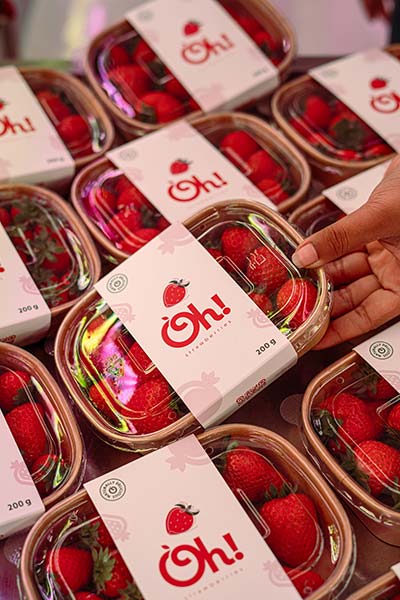
Although their company is called Fragaria, their main fruit brand is called Oh! Fruits. Harish talks about the name, “My two co-founders are foreigners, right? After the initial few months, they asked me why Indians say ‘oh’ so much. Are they reacting to something new? If so, they wanted to call the brand ‘Oh! Fruits’ because people wouldn’t have tasted strawberries like these!”
The climate-independent fruit factories are designed in a way to produce fruits regardless of weather or climate. Harish walks through the process, “Plants need sunlight, water, climate, and nutrients. We give them everything, but in a controlled setting. Artificial light, hydroponic irrigation, and a climate setting similar to that of Scotland or Amsterdam. It’s funny because they’re really just in a parking lot in Chennai,” he chuckles. “This is the magic of technology and the beauty of what my co-founders have created. They have codified everything and have made predictions and management as accurate as possible. Having worked on growing strawberries for over 10 years, they are equipped to design adaptable technology systems.” From humble, unassuming beginnings, they’ve come a long way.
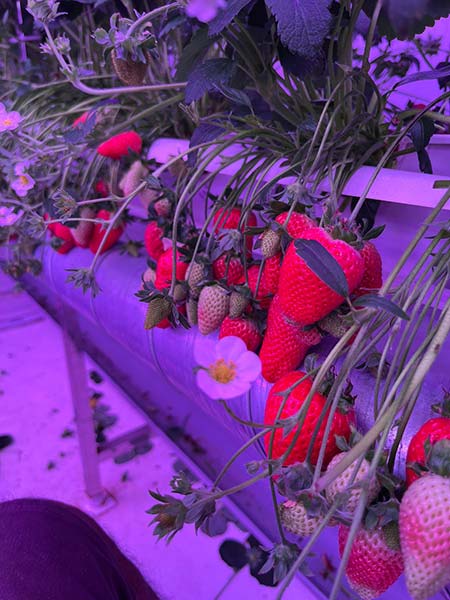
“We had our apprehensions when we started, as with any business, but we figured that the best way to understand the market is to put our product on shelves and just observe. No marketing whatsoever. Our strawberries sold out in hours, and people came back asking for more. We knew we had something good. For us, success isn’t just revenue, it’s when 90% of the fruits sold in India can be deemed world-class. As long as the quality of fruits here is upgrading, we’re happy! The government should also recognise the value of controlled environment farming and develop regulations for it, making it easier for future brands to streamline their process.”
To conclude, Harish speaks about what drives him every day, “I’m very happy on a Monday, which annoys people around me,” he laughs. “Ever since I was a child, I’ve wanted to prove to the world that I can amount to something. And now, doing something I’m so passionate about, I’ve never felt more alive! I was making big money in my previous jobs, but I’ve never been this happy. What more can I ask for?”