
Karthik Narayan, a medical doctor trained in geriatrics, started Athulya Senior Care in 2017. He finished a business course in the US, lived there for 10 years, and worked in a hospital’s geriatrics department before returning to Chennai.
Karthik’s main reason for relocating back to India was to start a professional geriatric care organisation. “Here, in India, when you talk about elder care, what immediately comes to mind is old age homes. And the minute you say those words, you think of sadness and darkness. I want to change that, and I think in some capacity, we have. I wanted to create a place where people want to go, and more importantly, change the term from ‘old age home’ to ‘assisted living’, because who likes to be called old?” he chuckles. The first step is to break the stigma and taboo is the nomenclature itself, and it worked. Athulya is now the largest assisted living operator in India.
He talks about how precious grandparents are to every family, and that they deserve a dignified platform where they can choose to age at their own pace, without feeling like an obligation. In an era where every family member is busy, the elderly are left alone, which is less than ideal. In South India, a big chunk of the population has moved abroad, and their parents have to live alone and manage their health and daily needs on their own. It’s a vulnerable population that requires close attention. The geriatric space is a rather untapped space, and Karthik aims to do his part to help.
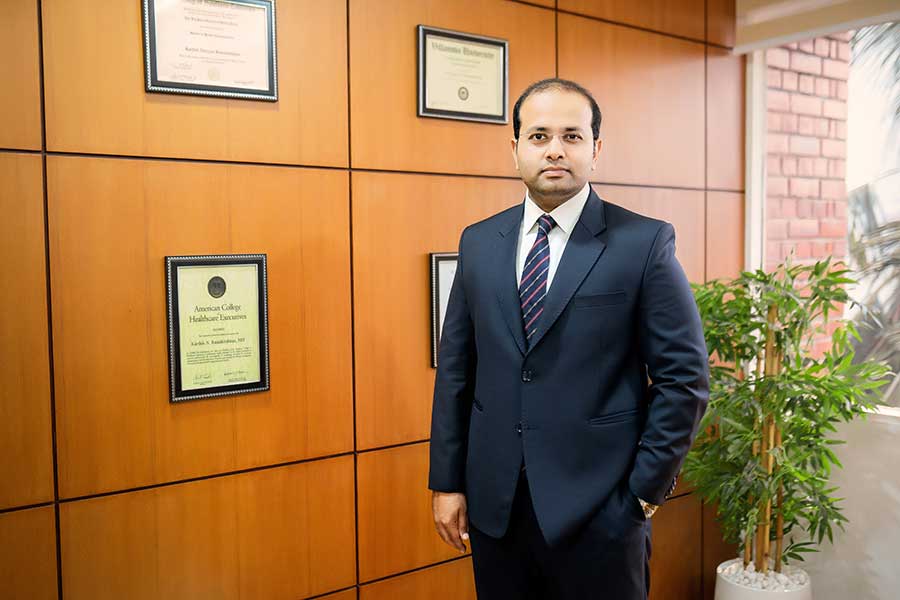 Dr. Karthik Narayan, the founder of Athulya
“To give a few parallels, India has about 7,000 beds for elder care, and China has close to 80 lakh beds, so imagine the disparity in resource availability. This is why I wanted to get into this field and go deeper into fixing the cracks in the system. In India, the standard idea is to retire, buy a villa somewhere in the outskirts of the city, and move to be at peace. What you also have to consider is emergency care, companionship, medical services, maintenance, and liabilities. When people are in that stage, as I like to call it, the second best half of their lives, why should they go through so many complexities? It should be flexible. We, at Athulya, created a co-living model for elders where they can come, live their lives, and have a good time,” Karthik describes.
Private rooms, round-the-clock nurses and doctors, no lock-in clause, no long-term lease, and no contracts. You stay for a day, a week, a month, or years. It’s entirely up to you. “Elders find it difficult to manage day-to-day affairs, housekeeping, laundry, or a kitchen. We made a subscription package where all of these are included. Everything is taken care of for them; all they have to do is stay here and enjoy their time. It’s essentially a service apartment model with integrated medical services,” he says.
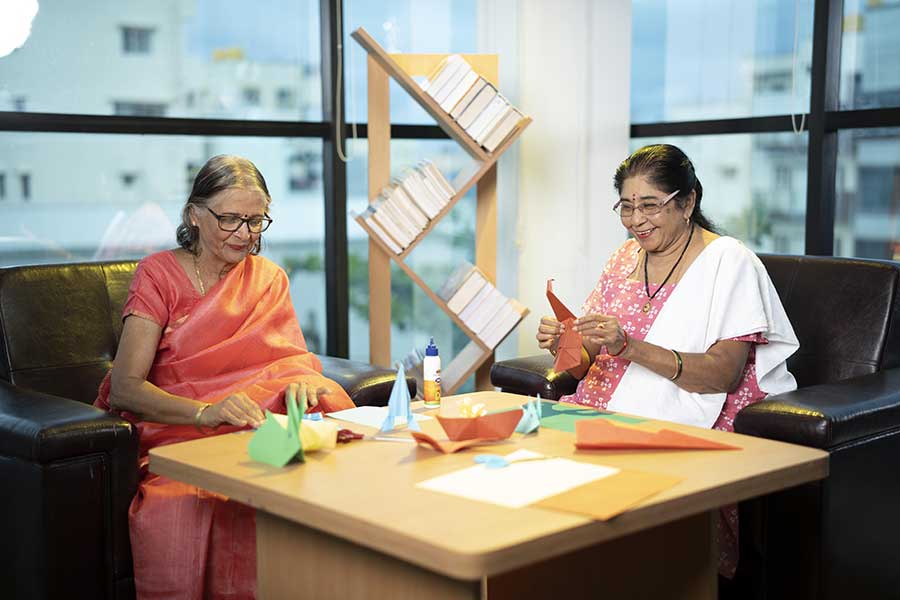 An origami class for the elders in the facility
Athulya senior care centres are now operational in five cities with over 1,500 beds: Chennai, Hyderabad, Bangalore, Cochin, and Coimbatore. They are also planning on expanding to Mumbai and Pune and making it 5,000 beds in the near future. Karthik says, “Along with location expansion, we’re now a fully integrated geriatric care company—we have a hospital and also offer home care packages. If someone has been through a surgery, we have packages for nursing care and physiotherapy for however long the patient needs.”
Athulya plans to focus their efforts more in the South because of the higher concentration of senior citizens and NRIs. Their corporate office has about 200 members; including the people working across facilities, the team is close to 1,300 now, and 70% of their workforce is women. They have a skill development centre where they recruit aspiring women from tier-2 and 3 cities, fully sponsor their education and training, and employ them to work with the company.
The Bangalore Athulya facility
When asked about challenges in the journey, Karthik elaborates, “The main thing is bringing awareness on the topic. It’s not an easy decision for families to put their parents or grandparents in elder care facilities, so we need to help people understand that it is a good idea. They deserve quality of life, they need 24/7 monitoring, like-minded people around them, a social life, and most importantly, they don’t want to be considered a burden. We do a lot of talks at IT companies, resident welfare associations, corporate offices, and forums to educate more people at a community level. Another challenge is that people don’t see elder care as a lucrative career, which is why we set up our training academy, to show them how important a job it is.”
He brings up another salient, usually ignored point—policy-making. How often do we see a bus or park to be senior-friendly? Public infrastructure has to be upgraded in terms of elders and their needs. His suggestions include an identity card for senior citizens, wheelchair-friendly pathways, senior-inclined public transportation, and a helpline that they can call anytime they need assistance. He is part of the National Human Rights Commission for the elderly in India and is on the technical committee for policy drafting. Initiatives are being taken, he says, but it takes time for them to come to fruition. One outcome has been setting minimum standards for elder care homes. A lot of work is yet to be done.
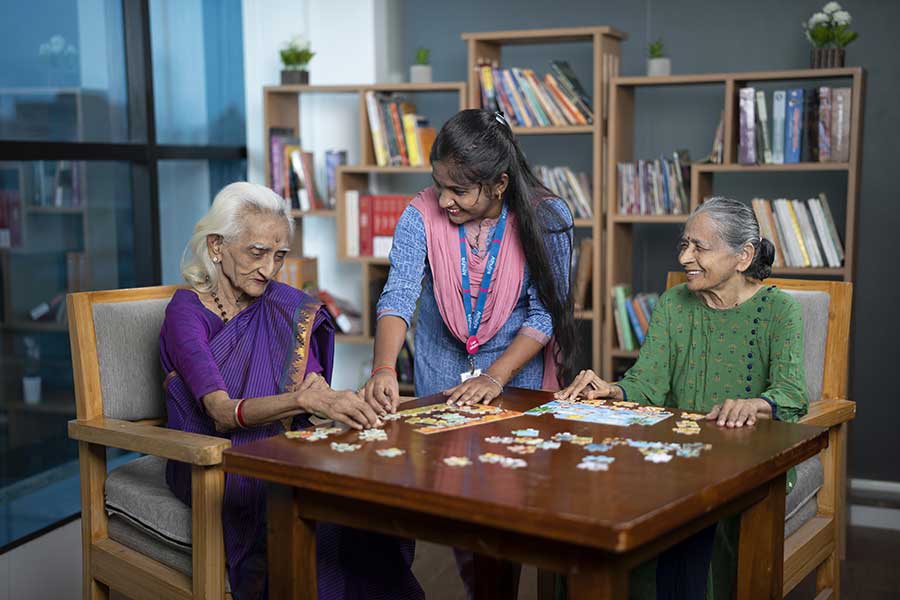 The seniors at Athulya work on a puzzle
Karthik talks about quality of life when it comes to elder care and misconceptions that surround it. “Many times, the children will want to make certain decisions about their parents, medical or otherwise, but they wouldn’t have talked to them directly about it. It’s imperative to have early conversations on medical decision making, because sometimes it’s too late, and the children have to live with the guilt and stress. Abroad, you can create a ‘living will’, making it easier for elders to make all their decisions when they are fully equipped to do so. India followed suit, it is now valid here. It’s a very interesting decision, and highly beneficial.”
He mentions how community integration is vital to a concept like elder care. As a society, we are not easily inclined towards the idea, but Karthik says it must start at home or the doctor’s office. “If children take their parents to a doctor after multiple falls, for example, the medical practitioner can ask them to consider assisted living. The parents might live alone and the child might travel often—it’s a sensible idea to be safe, among other people, and monitored.”
On the topic of a story that made Karthik realise that they were doing something wonderful, he talks about how important environment is. “There was a man who was terminally ill. The doctors said he has days or weeks left and to take him home. The family wasn’t ready or prepared to accept death in their house, so they asked if he could peacefully pass at our facility. We accepted. Usually, when someone has little time left, they are kept alone in a room and it gets extremely depressing. We, at Athulya, have a different appoach. We put him in a wheelchair, took him outside, and gave him nutritious food and exercise. He ended up staying with us for a year,” he smiles.
“Peer group interaction can be a great way of building confidence, and the social aspect allows them to make new memories, bringing about a positive change in behaviour. For families who are skeptical, they can try it out for a day or two, and then decide. No commitment, no strings attached. Our rooms are like hotels, you have in-room dining, art and exercise classes, and that can change their perspective on where their parents are moving to. Everything inside is senior-friendly, from flooring to lighting to furniture,” he explains.
What keeps him motivated? The real, social impact that the company is making with a section of the population that has been left out so far. Now, they have dedicated infrastructure and services designed for them. He concludes, “The future is in the hands of the young people, but what about the people who built it? It feels good to give back to them.”
The company received $10 million in funding from Morgan Stanley, which is a first in foreign direct investment into geriatric care.