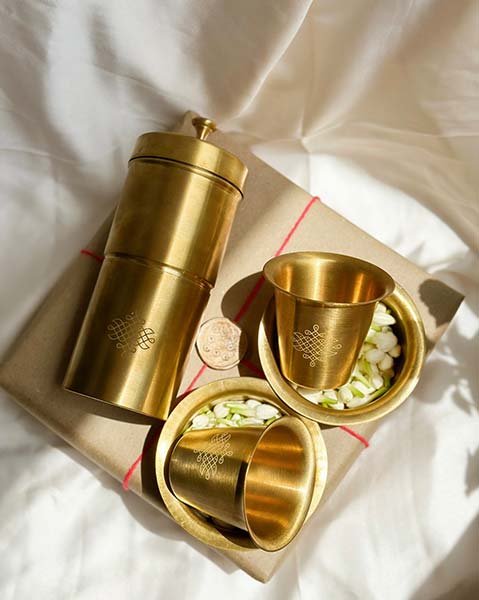

Why are Mumbai and Delhi the first cities that come to mind when people think about things to do or shops to check out? Nivedita Ganeshram, upset at how people thought there was nothing cool in Chennai, started Madras Finds to promote local talent.
Nivedita Ganeshram, the founder of Madras Finds, started the brand as a discovery platform during COVID, promoting local brands through her Instagram page. It slowly evolved into a brand selling inherently South Indian art and culture. “During COVID, I started a page spotlighting local artists and small businesses, since so many of them had opened during lockdown. The community grew organically. Once the lockdown was lifted, we organised a pop-up, which was very successful, and to date, our pop-ups have the highest walk-ins in the city. One day, I suddenly thought of designing pulli kolam playing cards with each suit designed as a different kolam. People loved the cards when we launched them! We realised that we had something going for us, and began making more products,” Nivedita says.
Next, they introduced their kolam davra set, which was also a big hit with people who craved rooted, culturally relevant heritage products that were also contemporary and utilitarian. They also experimented with Madras checks coasters and Madurai malli candles, essentially translating and elevating culturally rooted elements through creativity.
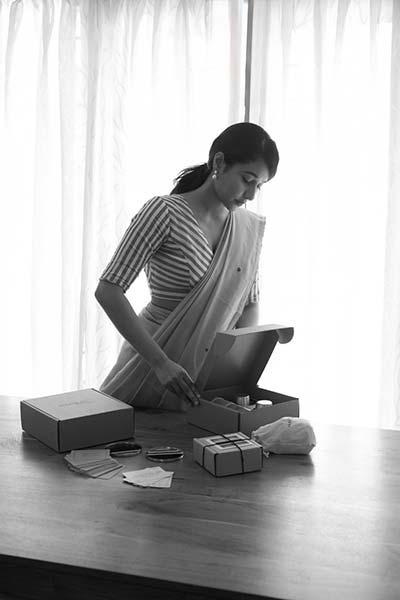
Nivedita grew up as a classical dancer, starting at just 4 years old. Being introduced to the world of South Indian folklore and aesthetics at such a young age shaped her into someone deeply entrenched in the culture. “When you think of India, your mind generally goes to the North. The South is, unfortunately, always underrepresented. When I started my page, I made sure I was including brands that were unique in some way. I chose brands that put a lot of thought into the products and packaging, and told a story. Storytelling is, I feel, imperative to selling your brand, which is what we follow with our own brand too,” she explains.
She talks about her hopes for Madras Finds, “I want to scale this brand globally, as our tradition and culture have a lot of intricacies. It’s layered and has deep meaning. I hope to see someone in New York pick up our Madras checks coasters! I truly feel that people worldwide should know and learn more about our culture, not just as a visual language, but also the meaning and significance behind it. Our latest launch, for example, is a drishti bommai keychain. The evil eye symbol is used everywhere, in jewellery, as bag charms or keychains, but you don’t see the drishti bommai motif amongst the younger generation. Naturally, we want to tell stories that highlight how interesting the concepts are in our culture.”
The main philosophy behind Madras Finds’ products is how a way of living stays present as the world moves on. The brand isn’t trying to preserve culture, per se, but rather the sentiment of it. Culture is not meant to be stagnant; it is meant to evolve. They look at markets, rituals, kitchens, and coastlines, to name a few, across South India to translate into products. They take motifs that people can resonate with and materials that they can seamlessly integrate into their lifestyle. They are working on exciting collaborations with other artists who are just as passionate about South Indian culture.
Nivedita mentions how connected people are to their roots globally, “One of the biggest things I realised after starting Madras Finds was the sheer number of people who have a craving to be more connected to their culture. The majority of our orders go to the US, and we’ve also shipped to Tokyo, Australia, and Ireland. One of the most memorable customer stories we have is of a German tourist visiting India who bought 50 of our postcard sets to gift everyone back home. She had no idea about South Indian culture, and I understood then that when a story is told in a relatable way, it can be meaningful to anyone, no matter where they’re from.”
She called the tourist to introduce herself and thank her for the order, and to understand what prompted her purchase. “She told me she was visiting multiple places in India, like Goa, Mumbai, and Madurai. Chennai was a pitstop, but our postcard set was the product she decided to take back as a souvenir for everybody back home. She said she had never seen anything like it before. It’s my favourite customer story from recent times,” Nivedita smiles.
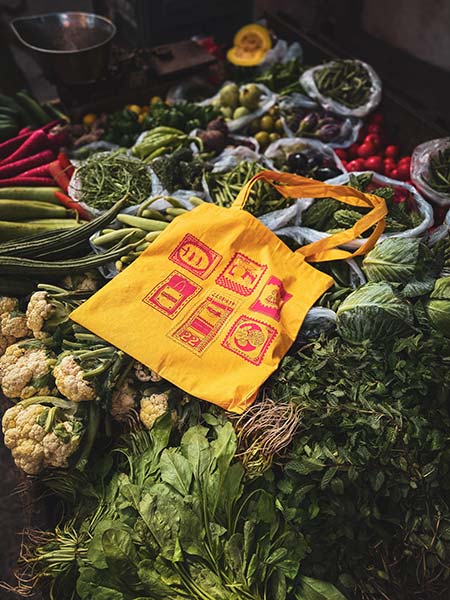
When asked about why she is driven to work relentlessly on her brand, Nivedita explains, “I honestly think it’s the team and community that drive me. The community we built happened over time and happened so organically; nothing was forced. It happened because of how interested people were in our culture, and the simple fact that someone dove headfirst into promoting local art and businesses. I really hope that one day, when I’m visiting another country, a piece of South Indian culture will be popular and spoken about widely across different nationalities and cultures. In India, people are so taken with other cultures. People know more about Korean, American, or European cultures and less about India, a country with so much heritage and craftsmanship.”
She gives an example of a koodai or bags that are made locally. The fabrics and the handicrafts that exist in India, and the South, especially, are so relevant, but not well-preserved, because of waning interests. “We recently visited a craft house in Karnataka where there was a carpet weaving unit. We learned that there are only 12 people left who know that specific weave, and after them, the art form will essentially be extinct. It’s the same thing with Kasuti embroidery, or art by the Toda tribes in the Nilgiris. Art has become so machine-led that people are losing out on their livelihoods, and in turn, the art itself becomes redundant. It’s important to preserve these parts of our culture and give artisans projects to sustain their art form for as long as possible,” she says.
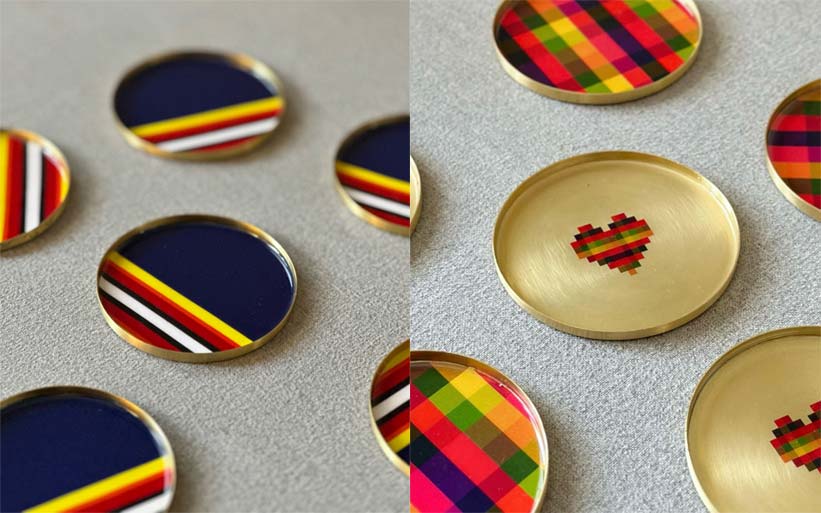 Jamakkalam coasters and Madras checks coasters
There is an unimaginable amount of art and culture yet unexplored in India, Nivedita insists. “From food to furniture to skincare and textiles, there’s a whole universe out there waiting to be seen. We, as a brand, work very intentionally towards growth, slowly creating original pieces. Our website was also created with a very nuanced outlook, as we are transparent about everything—whether it’s where the product is manufactured, or if a certain element was sourced directly from artisans. Sometimes, we buy a piece of packaging or something that we give as a freebie from artisans directly, supporting different communities. We also do a lot of research and think, “Does the world really need another set of coasters?” How can we make them stand out? We don’t want to promote overconsumption, so we put a lot of thought into everything we do. We like to call our products ‘heirlooms for the future’, because in our houses, there’s always something that’s passed on for generations and preserved with a lot of intention. That’s what we hope to be as well,” she concludes.