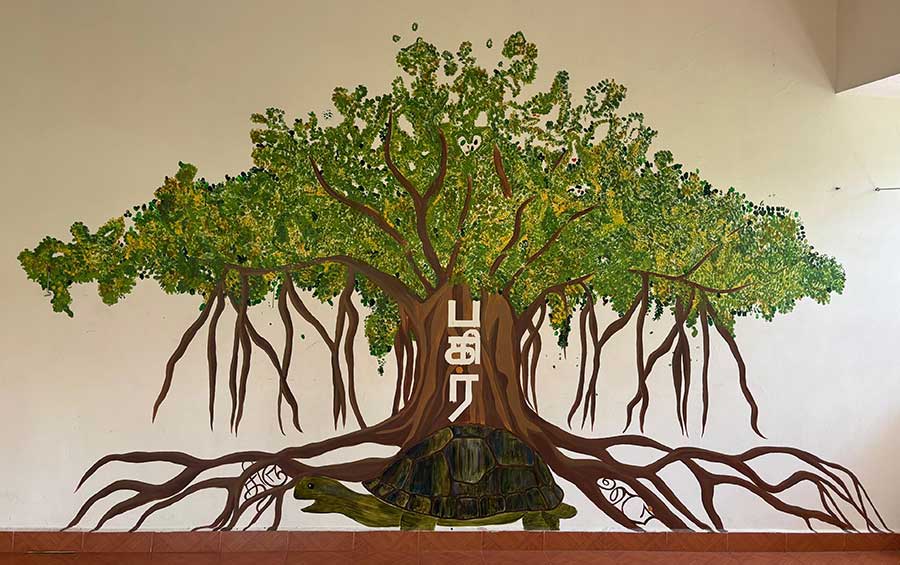

Tulika’s logo, Kaka the crow, a busy, intelligent bird that is an unmissable part of the sights and sounds of India. The word Tulika means the old-fashioned feather quill, dipping into stories old and new to give children a sense of their world.
When Radhika Menon, Founder and Managing Editor, started Tulika in 1996, there was no specialised children’s publishing house in India. “As a teacher, I felt the lack of good Indian children’s books. There were so many wonderful books from abroad, but when I tried to relate them to the Indian context, I was at a loss. My own colonial ‘English’ education did not equip me to find content that reflected a contemporary Indian reality. When we started publishing, we aimed to create caste-, class-, and gender-sensitive stories, and provide an empowering and inclusive reading experience. We want to build bridges across borders, and the responses over our 30-year journey have only reaffirmed our belief.”
How representative or inclusive can books really be when the languages children hear around them are kept out of the tales they read? Picture books were the natural answer—bridging the gap between oral and written language with culturally-rooted visuals. Children have vivid imaginations to embrace new experiences and are untroubled by expectations or boundaries. It was a very valuable insight, but it came with its fair share of challenges.
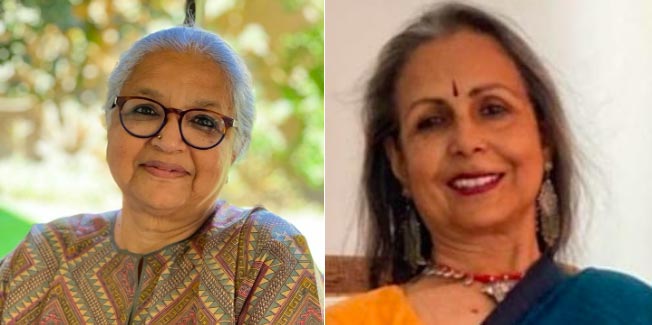 Radhika Menon, Founder and Publishing Director of Tulika and Deeya Nayar, Senior Editor at Tulika
Schools rejected the bilingual books they first published to be used in a classroom, but Tulika persisted. By publishing multilingual, multicultural books in several languages, they offer a range of experiences that represent different social milieus, childhoods and contexts. This can lead to children empathising with the situations of others, allowing them to see beyond their own limited circumstances, Radhika details.
Apart from being turned down by bookstores, a fragmented market and distribution are major issues they face, even today, affecting their visibility. As for issues within the industry, Radhika describes the lack of professionalism and training. There is talent, a lot of it, but the notion that children’s books are simple and low-effort has its own challenges. Publishing is fast-tracked, and the online space gives the feeling of instant success or gratification, making it difficult to nurture and hone skills.
We also talked to Deeya Nayar, Senior Editor at Tulika, who has been with the team for 28 years. She mentions how bookstores back then had a small section called ‘Indian Books’, where everything was dumped together, while all the foreign books would have nice, clear displays. Getting Indian books, especially multilingual ones like Tulika’s, on shelves took tremendous efforts. “Radhika had such a strong conviction about our work; she had no doubts whatsoever. She never gave up, no matter the setback,” she says passionately.
Radhika talks about how effective multilingual books are in promoting meaningful literacy. Children spotting words that they hear around them at home, in their native language, becomes a key factor in encouraging reading. That philosophy is what guides Tulika’s efforts, mainly publishing in Hindi, Tamil, Malayalam, Kannada, Marathi, Gujarati, Bangla, Telugu, and some even in Nepali, Odia, Khasi, Assamese, Bodo, Mundari, and Arunachali languages.
She talks about working on bilingual books. “It is a challenge, of course, to mirror the meaning, sentence construction, style, and syntax between English and its regional parallel. The text has to be translatable, and the two texts must convey the same without distortion or misrepresentation. They are most useful for the younger ages, where they can act as texts for learning languages.”
When it comes to choosing what stories to publish, Deeya says it’s mainly three things—instinct, substance, and meaning. Something has to ring true in a story pitch for the team to choose it. They are proud of the fact that they promote new writers and illustrators to foster unique, original voices. Training and nurturing talent in all aspects of children’s publishing is what is needed at the moment. It will take time and space to mature, which is a task, considering the realities of the publishing space.
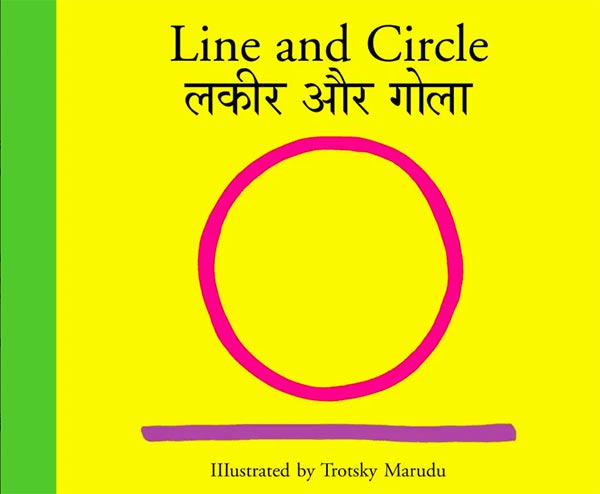 Line and Circle
When it comes to the writing and artwork, there are sometimes pushbacks about the style. Initially, although Western publishers were apprehensive about taking on Indian books, the scenario has changed today. Tulika’s books have reached countries around the world and are widely accepted and loved for their universally relatable characters. Deeya explains, “For us, our books having reached other parts of the world, balancing Indianness and universality is not too difficult, because there’s an underlying layer that is always universal. If a character or story has truth to it, it becomes universal, which is why the multilingual aspect is so important.
The biggest advantage of children’s publishing is how naturally open children are to alien subjects and ideas. Children revel in the unfamiliar and do not look at the stories from conditioned adult perspectives. Children are inherently multicultural beings, comfortable with the familiar and accepting of the strange, and are highly receptive to new experiences. This is primarily why the Tulika team does everything in their power to push a myriad of voices, stories, and art that can resonate with a child, no matter their background.
Tulika has won several accolades and awards over the years. Some of the most notable ones are the Literary Translation Initiative Award, which they received at the London Book Fair in 2019 and the Publisher of the Year Award at the Publishing Next Industry Awards in 2014. They also received, for the book ‘Jhupli’s Honey Box’, the Outstanding International Book from the United States Board for Books for Young People in 2023.
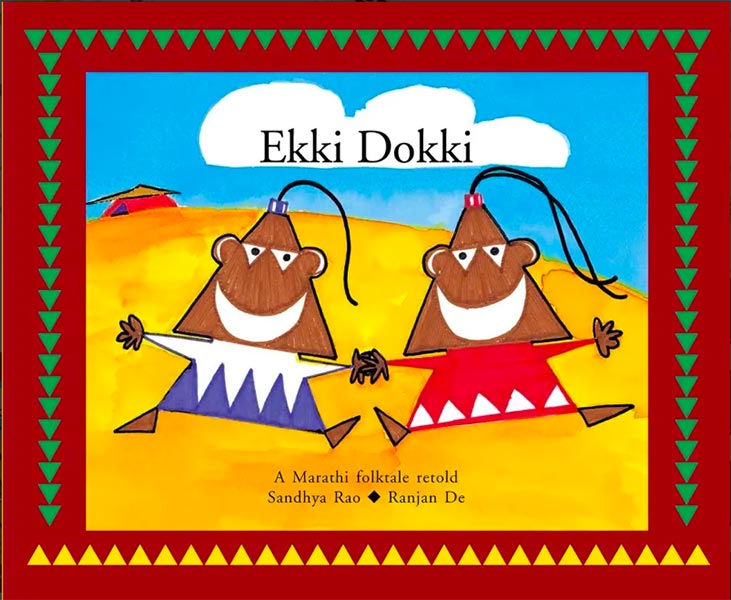 Ekki Dokki
Deeya talks about how deeply satisfying it is to work in a world of joy, creating stories with the potential to shape young children’s minds. Radhika mentions an incident from a government school in Kerala. A teacher handed one of Tulika’s books—The Mountain that Loved a Bird by Alice Mclerran—to a young boy who often bullied his classmates and was cruel to animals. The children in the class cried to her about how he had knocked a nest to the ground, cracking the bird’s eggs. He read the book repeatedly. He was so moved by the book that there was a marked change in his behaviour towards his friends and animals alike. That’s the impact a children’s story can have, no matter how simple it may seem.
“We are so fortunate to have the freedom to do the books we want to do and truly believe in. Whether they sell or not, it doesn’t matter. We don’t have a marketing team telling us what to do and what not to do; we get to make all the decisions ourselves. Seeing the responses from children is what motivates us every day. We don’t need any more validation than that. Children, books, and the coming together of both are what drive us,” she smiles.
Radhika describes the powerful reach and impact Tulika has had over three decades, “Our books have set new trends and ventured into untested waters, both in content and form. Now, they are mainstream and used widely across schools in cities and villages, playschools, activity centres, and libraries. They even reach street children, kids in remote corners, and kids of migrant workers through organisations that work with them. From rejection to required reading, it has come full circle!”
“In some capacity, we have achieved what we set out to do. Our vision persists and is as clear as it was on day one—children’s books should reflect what they see and hear, giving them an understanding of differences. For us at Tulika, it is a matter of hope, not expectation,” Radhika concludes.
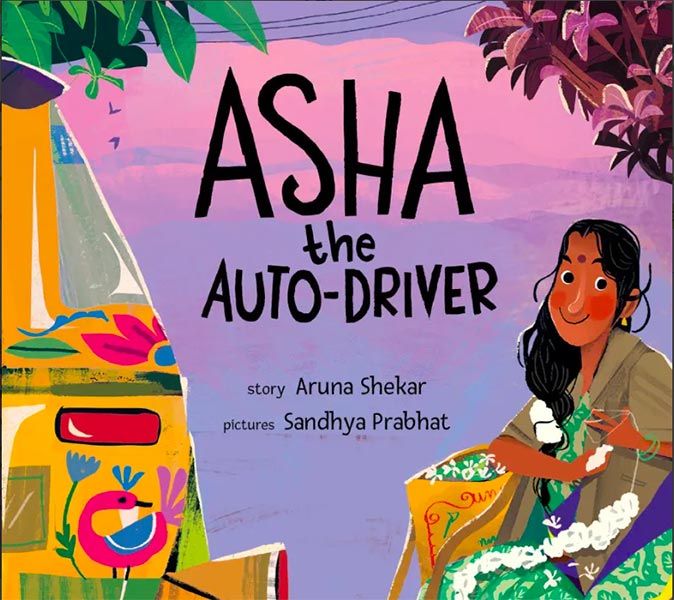 Asha the Auto-Driver
For further details, check the Tulika website www.tulikabooks.com/